
Table of Contents
1. Introduction :
Digital Marketing refers to the standard of marketing products or services through the usage of online marketing techniques such as processes of SEO, social media, PPC, email, and content marketing. In comparison to the conventional type of marketing, the business is able to access a wide audience of customers worldwide and at a lesser cost.
Digital marketing is now crucial in the business world today. Most consumers will first find information on the web before buying a product, so a robust digital presence creates trust, enhances visibility and improves sales. Digital strategies enable businesses both small and large to reach their customers, check on their output, and realize quantifiable progress.
By 2025, digital marketing will no longer be an option, it will be a required thing. Those businesses that are willing to invest in SEO, social media, and personalized campaigns will remain ahead of their competitors. Be it customer traffic, lead generation, brand awareness, it is what has provided business sustainability in the new, modern age.
2. What is Digital Marketing?
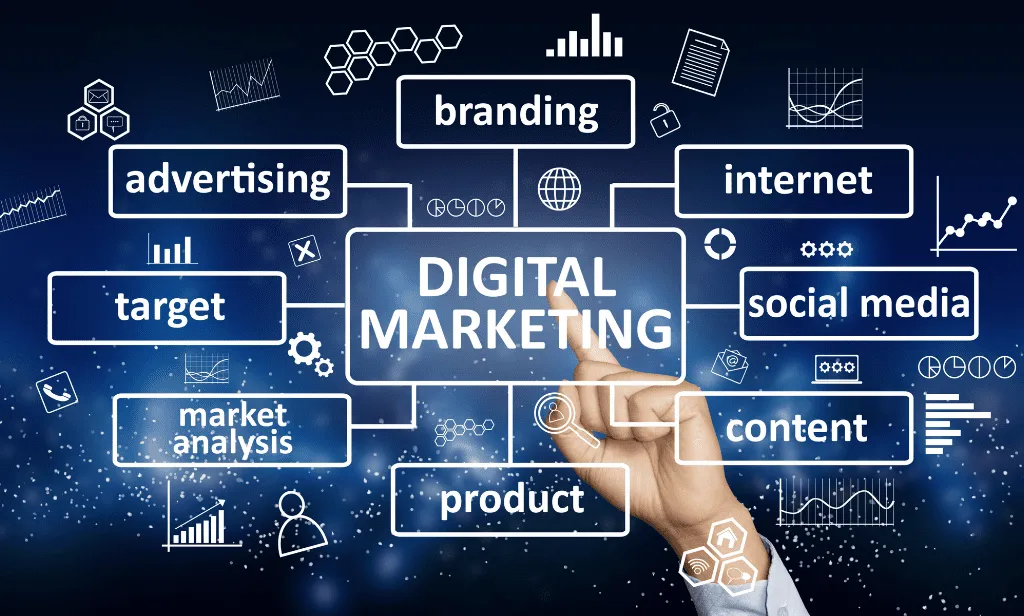
Digital marketing is the use of online platforms and tools to promote products, services, or brands. It has become a vital part of business strategy in 2025 due to its cost-effectiveness, measurable results, and ability to connect with a global audience.
- Definition and Scope:
Digital marketing covers strategies like SEO, content marketing, social media, email campaigns, PPC ads, influencer marketing, and more.
Its scope extends across industries, helping businesses of all sizes build visibility, generate leads, and drive sales. - Traditional vs. Digital Marketing:
Traditional marketing uses print, TV, or radio, which often require larger budgets and offer limited targeting.
Digital marketing allows businesses to reach specific audiences, track campaign performance in real-time, and adapt strategies instantly. - Key Benefits for Businesses:
- Cost-effective compared to traditional methods.
- Wider audience reach, both locally and globally.
- Higher customer engagement through interactive channels.
- Data-driven insights to improve performance.
- Stronger ROI with measurable growth and long-term results.
- Cost-effective compared to traditional methods.
3. Core Components of Digital Marketing :
Digital marketing consists of various relevant components, which combine to assist businesses connect with their audience, increase visibility and lead to outcomes, on the Internet.
- Search Engine Optimization (SEO): SEO is used to position them higher on Google search results, where people can find them easier. Higher rankings have the effect of driving more organic traffic and online presence.
- Content Marketing: Blogging, video, and infographic enable companies to express important information that informs, entertains and creates a good relationship with their readers, viewers and subscribers.
- Social Media Marketing (SMM): Facebook, Instagram, LinkedIn, and X (Twitter) give brands an opportunity to share updates with customers, connect with them, and build meaningful relationships.
- Email Marketing: Email marketing involves personalized e-mails to maintain contact with the customers. It assists with generating leads, communicating, and developing longer-term relationships because it produces content that feels engaging and valuable.
- Pay-Per-Click Advertising (PPC): PPC is the use of paid ads that are displayed on a Google Ads or Meta Ads platform. Such advertisements provide immediate exposure and enable companies to engage special and narrow customer segments within the shortest possible time, so it is one of the fastest methods to promote traffic and sales.
- Affiliate Marketing: Partnering with influencers and partners can allow businesses to expand their presence and find new customers.
- Mobile Marketing: Messages sent via SMS, push notifications, and applications allow companies to reach their customers in their mobiles.
Collectively, these elements are the pillars of online marketing that can assist companies expand their brand, generate leads, and realize quantifiable success in 2025 and beyond.
4. Latest Trends in Digital Marketing (2025) :
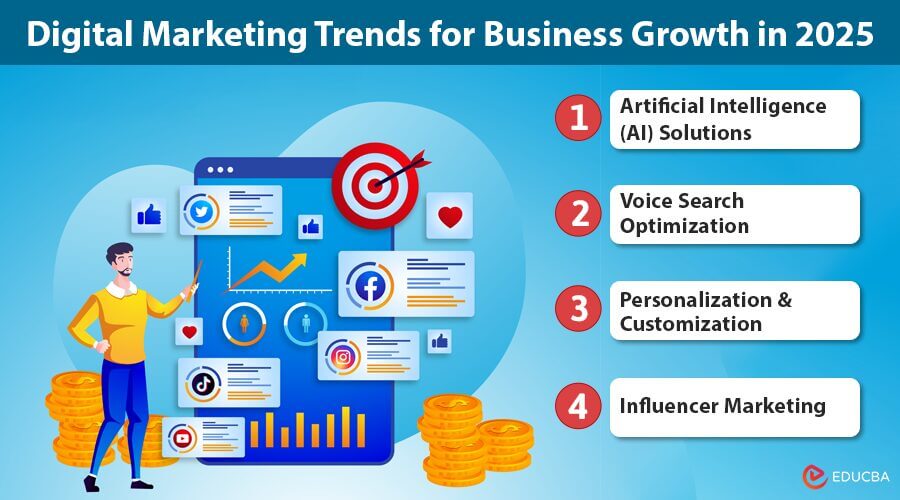
Digital marketing in 2025 is evolving rapidly, and businesses are adopting new strategies to stay competitive online. The focus is shifting toward innovation, personalization, and building meaningful customer relationships. Here are the top trends:
- AI and Automation – Smarter ad campaigns, predictive analytics, and chatbots are reshaping customer experiences with data-driven efficiency.
- Voice Search Optimization – With the rise of smart speakers and mobile assistants, optimizing for voice search is now crucial for visibility.
- Video & Short-Form Content – Platforms like Instagram Reels and YouTube Shorts dominate, offering quick, engaging ways to connect with audiences.
- Influencer Marketing 2.0 – Authentic partnerships with micro-influencers are helping brands resonate with niche communities.
- Personalization with Data Analytics – Tailored content improves customer engagement and boosts conversion rates.
- Sustainability & Purpose-Driven Branding – Consumers prefer businesses that align with their social and environmental values.
In 2025, Online marketing success depends on leveraging these trends to create deeper connections, improve engagement, and drive long-term growth.
5. Benefits of Digital Marketing for Businesses :
In 2025, digital marketing will be a necessity to any business as it provides a low cost solution, the results are quantifiable, and the marketing strategy can be measured effectively. Here are the key benefits:
- Cost-Effective – It enables organizations of any scale to tap into larger audiences at a fraction of the cost as compared to traditional marketing which requires a huge budget to make such a venture effective.
- Expanding the number of people reached – SEO, social media and online campaigns enable businesses to reach potential customers within their area, across their country and internationally.
- More Powerful Customer Response – It becomes easier to develop trust and ongoing relationships with the customers through the use of social media platforms, personalized email, and interactive content.
- Intelligent Results – Analytics applications visualize performance, streamline plans, and enable smarter and better-informed choices in business.
- Best ROI (Return on Investment) – Digital marketing is a tool that creates quality leads, boosts sales and sustainable growth without spending a lot.
With these advantages in place, businesses can sustain themselves, optimize their presence online, and succeed in the era of the digital first.
6. Challenges in Digital Marketing :
- Increasing Competition – As more brands go online, it is getting tougher to be different. Companies should apply new methods and innovative forms of communication to capture the interest of audiences.
- Privacy Issues – Customers want their personal information to be safe. To establish and retain trust, companies have to adhere to a set of rigid laws of data protection.
- Ad Fatigue and Trust Overcrowding – Customers are bombarded with marketing messages every single day, and it may decrease the efficiency of marketing campaigns and make the audience bored.
- Continuous Upskilling is a Necessity – Online marketing platforms, tools, and algorithms change quickly, and business and marketers need to refresh their skills on a regular basis.
- Proactive Solutions Lead to Success – By dealing with these challenges early, organizations can streamline their campaigns, improve relationships with customers, and keep up with the digital environment changing rapidly.
7. How to Build a Successful Digital Marketing Strategies:
The development of a solid digital marketing plan is the key to business expansion in 2025. The major steps involved are as follows:
- Identify your target audience– Learn who your customers are, their needs and their online behavior to create targeted campaigns.
- Create SMART objectives – To achieve the best outcomes, set SMART objectives which are specific, measurable, achievable, relevant and time-bound.
- Select appropriate digital channels – Select proper digital channels such as SEO, social media, email or PPC depending on your business purpose.
- Make interesting content – Use blogs, videos, and social posts that are valuable and attention-grabbing.
- Track and optimize performance – Track analytics and optimize campaigns and increase ROI.
An effective Online marketing program will enable organizations to remain competitive and attain long-term growth.
8. Future of Digital Marketing in India & Globally
In 2025, online marketing will necessarily develop at a very high rate, and new technologies and regional approaches will transform the nature of relations between businesses and customers. Key future trends include:
- Expand AI-Led Campaigns – AI applications such as predictive analytics, chatbots, and robots will facilitate smarter targeting, personalization of campaigns, and increased ROI.
- Customer Experience with AR/VR – Augmented and Virtual Reality will help generate the most interactive shopping experience, whether a virtual try-on in the clothing industry or an interactive product demo.
- Growth of Vernacular Content in India – India has a multilingual population, and regional and vernacular content will help the brand to create better relationships and access to unexploited markets.
9. Conclusion :
There is nothing like a trend in digital marketing in 2025–it is a requirement and responsibility to business growth and long-term success. It has become the foundation of contemporary business plans as it can connect with more people, achieve quantifiable outcomes, and establish a better connection with its customers.
- Summary of Significance – Online marketing enables companies to be competitive, affordable, and reach customers in a world where everything is digital in nature.
- Why Adapt Now – The rapidly changing nature of technology, AI-based tools, and the shift in the consumer mindset make it essential to move fast in business.
- Lasting Call-to-Action – Your start-up or established brand should begin learning how to market digitally, use the right approaches, or achieve growth by consulting professionals.
Q1: What are the most effective digital marketing strategies in 2025?
The top strategies include AI-driven campaigns, content marketing, SEO optimization, social media marketing, influencer collaborations, video and short-form content, email marketing, and personalization through data analytics. Businesses should combine multiple strategies for maximum impact.
Q2: Why is digital marketing important for businesses in 2025?
Digital marketing allows businesses to reach a wider audience, track performance with analytics, engage customers through personalized campaigns, and achieve higher ROI compared to traditional marketing methods.
Q3: Should small businesses invest in digital marketing?
Absolutely! Digital marketing is cost-effective and allows small businesses to reach targeted audiences, compete with larger brands, and generate measurable leads and sales.
Q4: How can businesses stay updated with the latest digital marketing trends?
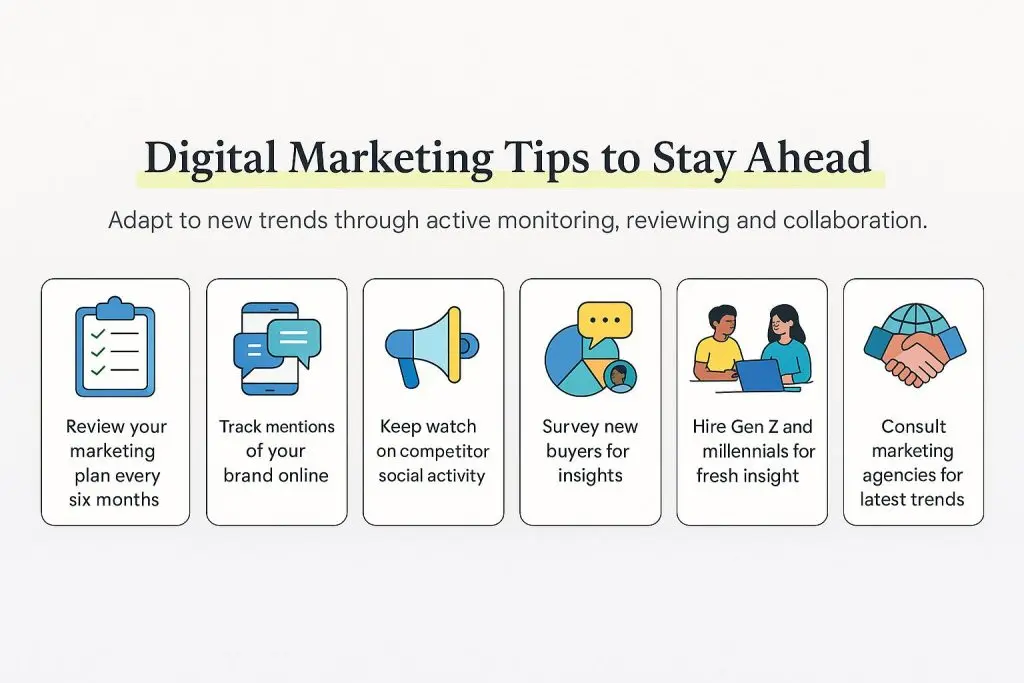
Following industry blogs, attending webinars, using analytics tools, experimenting with AI and AR/VR, and monitoring competitors are effective ways to stay ahead in 2025.